HRMS Software for Indian Companies
NeevHR is an India-first Human Resource Management System (HRMS) that brings employee management, attendance, leave, payroll, recruitment, performance, expenses, compliance and employee self-service into one platform.
What is an HRMS?
An HRMS (Human Resource Management System) is software that helps organizations manage employee information, HR processes, attendance, leave, payroll, recruitment, performance, documents and workforce reporting from a centralized system.
NeevHR combines these HR functions into one platform so HR, payroll, finance, managers and employees can work from the same employee record.
New to the term? Read the HRMS definition or compare HRMS and HRIS.
What an HRMS typically covers
- Employee information
- Organization structure
- Employee onboarding
- Attendance
- Shift management
- Leave
- Payroll
- Statutory compliance
- Recruitment
- Performance
- Compensation
- Expenses
- Employee documents
- Employee self-service
- HR reports
- Workforce analytics
- Employee exit and full & final settlement
NeevHR provides these capabilities in one India-first HRMS platform.
HRMS features
More than 30 modules run on one employee record, grouped below. Every item links to a page with the detail.
One Employee Record. One Source of Truth.
NeevHR maintains one employee record across the entire HR lifecycle. Promotions, transfers, salary revisions, organizational changes and other employment events are saved with their dates as a full change history, so nothing earlier is overwritten.
This allows HR and payroll teams to understand employee information as it existed at a specific point in time and reduces duplicate data entry across HR modules.
- Promotions, transfers and pay revisions saved with their dates
- Org charts and master reports as of any date
- Backdated revisions flow into payroll as arrears
Employee management
Every employee has one record that holds job, pay, statutory IDs, bank details, documents, assets and history. Every change is saved with its date, so you can see the record as it was on any past date.
- Employee 360 profile with job, pay, statutory and documents
- Multiple legal entities, locations, departments, grades and cost centres
- Bulk transfers, manager changes and mass separations
- Custom fields governed by a catalog
Attendance
Punches arrive from biometric devices, web check-in or file import. Shift, grace and overtime rules turn them into a closed attendance day that payroll can use without rework.
- Biometric punches over the ADMS (iClock) push protocol
- Shifts, rosters, weekly-off policies and overtime rules
- Regularisation requests with approvals and period locks
- Loss of pay derived from attendance and leave
Leave
Leave types, accrual, proration, carry-forward and encashment are rules you configure and assign to employee groups. Approved leave flows straight into attendance and payroll.
- Configurable leave types and accrual rules
- Holiday calendars by location, with restricted holidays
- Approval chains per leave type
- Balances visible to employees in self-service
Payroll
Monthly payroll runs from configurable pay structures, attendance and leave inputs, loans, reimbursements and variable pay, through compute, verify, approve and publish.
- Salary structures assigned by group, with pay revisions from their start date
- Arrears, LOP and LOP reversal, loans and variable pay
- Payslip PDFs, salary register and journal voucher export
- Bank payment files in generic and bank-specific CSV layouts
Recruitment
Requisitions, candidate pipelines, interview panels, feedback and offers are managed inside NeevHR, and an accepted offer becomes an onboarding journey without re-keying.
- Requisitions with approval and validation
- Pipeline board, interview scheduling and panel feedback
- Offers that carry the approved compensation
- Referrals and a talent pool
Performance
Goals, reviews and 360 feedback run in configurable cycles. Ratings feed compensation decisions, with sign-off by the right authority.
- Weighted goals and review cycles
- OKR and goal cascade, with key results
- Goal check-ins with history, and goals at risk
- Development plans linked to appraisals and learning
- 360 feedback and a 9-box talent view
- Rating distribution view for calibration discussions
- Increment and bonus decisions linked to ratings
Expenses
Employees claim expenses against policy, managers approve, and reimbursement is paid through payroll, and the person who pays a claim can never approve it.
- Policy-based claims with receipts
- Partial sanction and approval chains
- Reimbursement through payroll
- Travel requests with approvals
Compliance
Indian statutory calculations and filing outputs are generated from the same payroll run, with configurable statutory tables and DPDP Act 2023 privacy controls.
- PF, ESI, PT, LWF and TDS calculations
- PF ECR, ESIC contribution file, challans
- Form 24Q return file and Form 16
- Gratuity, statutory bonus and full & final settlement
Employee self service
Employees see their attendance, leave balances, payslips and tax declarations and raise requests themselves. Managers act on everything awaiting them from one inbox.
- Leave, regularisation, expense and profile-change requests
- Payslips, Form 16 and tax declarations with proofs
- Helpdesk tickets and surveys
- Confidential POSH complaints to the Internal Committee
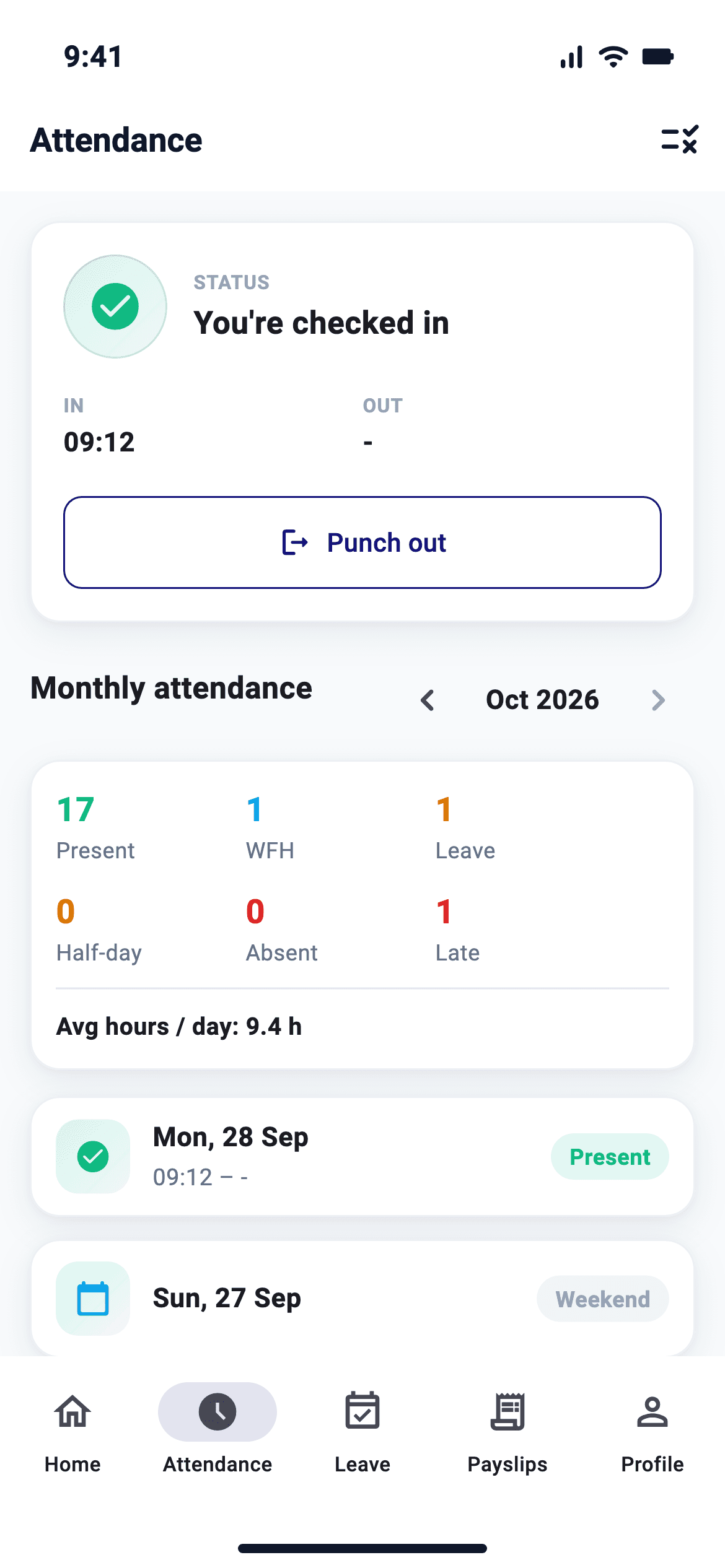
- Mobile app for Android and iPhone
HR analytics
A catalog of reports across modules, persona dashboards and a self-serve report builder, and you can click any chart to see the records behind it.
- Headcount, attrition, attendance and payroll reports
- Report builder with group-by and aggregation
- Scheduled reports by email
- Rule-based attrition risk with visible reasons
Security
Employee and payroll data is among the most sensitive a company holds. NeevHR protects it at the database, application and access layers, and hosts it in India.
- Each company's data kept separate in the database
- Field-level encryption of PAN, Aadhaar and bank details
- Access by role, with sensitive fields hidden
- TOTP MFA, enforceable per company
- Audit log of administrative and payroll changes
- DPDP consent, data principal requests, retention
Integrations
NeevHR connects to the systems around HR through open, documented mechanisms. Only integrations available today are listed.
Biometric devices
ADMS (iClock) push and punch file import.
Messaging
Email, SMS, WhatsApp and browser push, with your provider accounts. Approvals from Slack, Teams or WhatsApp, connected per company.
API & webhooks
Scoped API keys and HMAC-signed outbound webhooks.
Finance & banks
Journal voucher CSV and bank payment files.
Implementation
Implementation time depends on employee count, data quality, integrations and payroll complexity. Your HR administrator owns the configuration once you are live.
- Step 1
1. Configure
Entities, policies, pay structures and employee groups set up with your HR admin.
- Step 2
2. Migrate
Employee master, opening balances and documents imported and validated with a dry run.
- Step 3
3. Parallel run
Attendance and a parallel payroll cycle reconciled against your current process.
- Step 4
4. Go live
First live payroll, self-service rollout and reports handover.
HRMS software: frequently asked questions
What is HRMS software?
HRMS (Human Resource Management System) software manages employee records, attendance, leave, payroll, recruitment, performance, documents and HR reporting from one central system.
What is the difference between HRMS and HRIS?
An HRIS is mainly a system of record for employee data. An HRMS usually adds operational processes such as attendance, leave, payroll and performance on top of that record. Vendors use the terms loosely, so compare capabilities rather than labels.
What should an HRMS include for an Indian company?
At minimum: an employee master, attendance and leave, payroll with PF, ESI, PT, LWF and TDS, statutory filing outputs, employee self-service, approvals and reports. Growing companies usually add recruitment, performance, expenses and exit with full and final settlement.
Is NeevHR an HRMS or a payroll software?
Both. NeevHR is an HRMS with payroll built in, so attendance, leave and employee changes flow into payroll from the same employee record.
Who is NeevHR built for?
Indian organisations of roughly 500 to 5,000+ employees that have outgrown spreadsheets and disconnected tools.
Does NeevHR support multiple legal entities and locations?
Yes. Several legal entities, locations, business units and departments can run in one account, with state rules such as PT and LWF applied by work location.
Can policies be configured without code?
Yes. Leave, attendance, shifts, pay structures, expense and appraisal policies are configured in settings and assigned to employee groups.
Does NeevHR handle PF, ESI, PT, LWF and TDS?
Yes. They are calculated in each payroll run, and the PF ECR, ESIC contribution file, challans, Form 24Q return file and Form 16 are generated.
Does NeevHR integrate with biometric attendance devices?
Yes. It accepts punches over the ADMS (iClock) push protocol used by many eSSL, ZKTeco and Matrix devices, and through punch file import. Device compatibility is confirmed during implementation.
Does NeevHR have a mobile app?
The app for Android and iPhone is built and coming to Google Play and the App Store. Today employees use self-service on the web, including from a phone browser.
How secure is employee data in NeevHR?
Each company's data is kept separate inside the database (Postgres row-level security), sensitive identifiers are encrypted at field level, access is role-based with data scopes, MFA is available, changes are audit-logged, and data is hosted in India.
Does NeevHR support the DPDP Act 2023?
NeevHR provides consent records, data principal requests (access, correction, erasure, grievance, nomination), retention schedules and legal hold to support your DPDP Act 2023 obligations.
Does NeevHR integrate with other systems?
Yes, through scoped API keys, signed outbound webhooks, CSV import and export, and accounting files for Tally Prime and Zoho Books that your team imports. Sign in with Google is available, Microsoft is being switched on, and SAML is not built.
How long does HRMS implementation take?
Implementation time depends on employee count, data quality, integrations and payroll complexity. It usually covers configuration, data migration, a parallel payroll run and go-live.
Can we migrate from Excel or another HRMS?
Yes. Employee master data, org structure, documents, leave balances, loan balances and year-to-date payroll opening balances are imported from CSV with dry-run validation.
How is NeevHR priced?
Pricing is based on employee count, modules, implementation requirements and integrations, in INR, with edition-based packaging.
Is NeevHR available in Hindi?
Yes, for employees. Every self-service page and the mobile app are available in Hindi, and the AI assistant replies in Hindi or Gujarati. Admin screens are in English today.
Can we see NeevHR before deciding?
Yes. Book a demo and we will walk through NeevHR using a structure close to your own policies and pay setup.
Choosing an HRMS, or switching to one
By company size and need
Moving from what you use today
See the NeevHR HRMS on your own policies
A walkthrough mapped to your entities, pay structures and approval flows.